

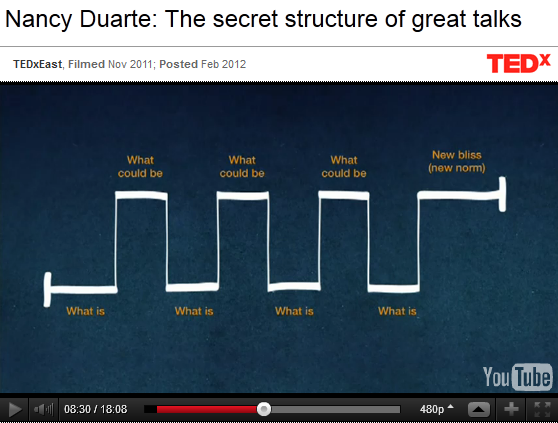

 Here's another excellent Ted Talk with an important lesson for your sales team. In this 18-minute presentation, Nancy Duarte highlights "The Secret Structure of Great Talks." And while her focus is more on presentations and speeches - she uses her structure to map and highlight Steve Jobs' 2007 launch presentation for the iPhone as well as Dr. Martin Luther King's famous speech, "I Have a Dream." If you listen carefully there are several key points that apply to sales conversations:
- Creating awareness of the gap between "the way it is right now" and "the way it could be" will pull the audience toward you and create more urgency to take action.
- Establishing a rhythm by traversing between various aspects of "the way it is now" and "the way it could be" creates a more compelling and interesting conversation, building momentum until you end with a new vision for the future.
- Harnessing the natural resistence we encounter as we ask people to change by tacking back and forth from "what is" to "what could be" and using that natural resistance to actually draw them closer to our vision and idea.
- The difference between an audience (or a prospect) choosing a mediocre idea (or product/service) over a more clever idea (or product/service) is often simply a matter of how you communicate that idea.
- Using archetypical examples, personal stories, appropriate emotional examples, and familiar analogies makes it easier for the audience to engage and understand your vision.
As you think about the type of conversations your sales team has, how often do they start by spending some time on "the way things are now" and end with a vision for "the way it could be if you used our product/service?" Do they spend enough time asking questions about "the way it is now" and helping the prospect discover the problems and consequences of sticking with the status quo? How effective are your sales people at creating as wide a gap as possible between what is and what could be? What would happen to your sales results and business growth if everyone on your sales team mastered this approach?
Please enjoy a great presentation from Nancy Duarte on "The Secret Structure of Great Talks."
If you would like talking points and a meeting outline with ideas about how to use this at an upcoming sales meeting, please let me know.